sir william petre
(1505-1572)

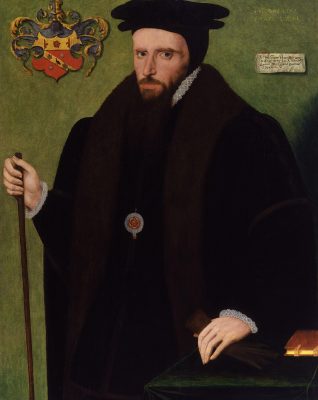
Biography of Sir William Petre (1505-1572)
Sir William Petre was best described as one of the political and social leaders of Tudor Times. He was tutor to Queen Anne Boleyn’s brother, George, and became one of the two Principal Secretaries to King Henry VIII and a member of the Privy Council on or about 21 January 1544. Remarkably he was to serve in this capacity almost all of the Tudor line, King Edward VI, Queen Mary and finally for a short while Queen Elizabeth. Sir William Petre, having been knighted on taking office as Councillor and Secretary of State, personifies many of the significant trends of Tudor times.
From humble origins in Devon and the son of John Peter and his wife Alice, daughter of John Colin. The place of William Petre’s father in the social scale, as a rich farmer and freeholder of the manor, probably lay between that of yeoman and gentleman. In the national subsidy lists of 1523 John Peter was assessed on goods to the value of £40. There were fewer than 500 taxpayers at this level in the whole of Devon. The Petres were numerous in Devon before the sixteenth century.
Sir William was educated at the great West Country college of Exeter, at Oxford, arriving there in 1520 when he was about 14, he was elected Fellow of All Souls in 1523 where he graduated Bachelor of Civil and Canon Law on 2nd July 1526.
He became in about 1527 the Principal of Peckwater’s Inn or Vine Hall, and tutor to George Boleyn. It was no doubt through the influence of Boleyn’s sister Anne that Petre came to the notice of Thomas Cromwell.
Having been sent abroad and resided on the continent, chiefly in France, for more than four years. On his return, he was appointed a Clerk in Chancery and All Souls made him Doctor of Civil Law on 17th February 1532.
Around 1533, Sir William married Gertrude, youngest child of Sir John Tyrell of Little Warley Hall and his wife Anne (daughter of Sir William Norris and his wife Jane, a daughter of the 12th Earl of Oxford).
In 1534, Sir William and Edmund Walsingham examined Anne Hussey on the charge of addressing King Henry’s daughter Mary as Princess, when Anne had stayed with her at Hunsdon, and whether she thought her the lawful daughter of the king. Anne Hussey, knowing her head to be in danger if she continued to support Mary, took the more prudent way and sought pardon. ‘She most humbly beseecheth his Highness of mercy and forgiveness, as One that is repentant for that she hath so offended and purposeth never hereafter to fall in to semblable danger, – signed Anne Husee, countersigned Edmund Walsyngham. Per me Gulielmum Petre’.
From his youth Sir William must have been a capable, pushing, insinuating man. He was only about thirty when he was already in high favour with Cranmer and Cromwell, who spoke in November 1535 of making him dean of arches, there ‘being no man more fit for it’.
As a Visitor of Monasteries Sir William administered the closure of many religious houses for the King, but yet managed to win sufficient gratitude from the Papacy later to earn him in November 1555 a Papal Bull absolving him from every excommunication, suspension and interdict and other ecclesiastical censures and penalties for having acquired land which formerly belonged to the church. Among mid-Tudor privy councillors, Sir William is unique in his unbroken service; he alone escaped the block, the Tower, house arrest, disgrace, fine, exile, or enforced retirement. As a diplomat, his manner was ‘smooth, reserved, resolved, yet obliging’.
In 1537 Sir William was employed to examine Robert Aske and other prisoners taken in the Lincolnshire and Yorkshire rebellions.
Soon he was actively visiting and aiding in the suppression of the smaller monasteries, he was one of the most zealous of the visitors. Among the twenty monasteries he visited and procured the surrender of in 1538 were, perhaps, St. Leonard’s, Thoby and Blackmore. In the first three months of 1539, thirteen more fell before him; he being instrumental in the almost total extirpation of the Gilbertines, the only religious order of English origin. A few years later, he was Visitor of the greater monasteries in Kent and the South of England.
In 1539, Sir William was appointed to prepare a bill for the enactment of ‘The Six Articles’, and in the following year was on the commission that declared the nullity of King Henry’s marriage with Queen Anne of Cleves. Early in 1543, he was knighted, appointed Secretary of State in Wriothesley’s place and placed on various commissions to inquire into causes of supposed heresy. In 1544, King Henry made Sir William a Privy Councillor, and on 9th July 1544, one of his two Principal Secretaries selected to assist Queen Catherine in carrying on the Regency in the small ‘Regency Council’ during King Henry’s absence, and to raise supplies for the King’s expedition to Boulogne. In 1545, he was sent abroad as ambassador to the great Emperor Carlos V, but at the end of the year was summoned back to the Privy Council.
His second wife, Anne, Lady Petre, was born in 1509, the daughter of William Browne, a London merchant who died during his term as Lord Mayor of London in 1514. By March 1542 Anne had married Sir William bringing him an increase in income of £280, from the lease of a farm at Dunton near East Horndon, and from manors in Cambridgeshire and Hampshire.
When King Henry VIII died in 1547 Sir William was appointed an assistant executor to his will. This gave him much hold over King Edward VI, and his power, importance and activity rapidly increased. In August 1547, he was entrusted with the Great Seal for use in all ecclesiastical affairs.
In 1549, Sir William served on commissions to visit the University of Oxford inquiring into heresies, to examine the charges against Lord Seymour of Sudeley. On 6th October 1549, he was sent by Protector Somerset to the council to demand the reason for their coming together, though at first a supporter of Lord Somerset. Finding them the stronger party he deserted Somerset just before his fall, remaining to sign the council’s letter to the lord mayor denouncing the protector; four days later he also signed the proclamation against Somerset.
By the 1550s, Sir William was very prosperous. Not only was he Secretary of State but he also had many other sinecures such as warden of the Bishop of Winchester’s lands. He enjoyed many rewards such as free board and lodging at court. In February 1550, he was sent to Boulogne to negotiate the terms of peace with France, and in the following May exchanged ratifications of it at Amiens. Sit William is described as smooth and obliging in manner, yet reserved and resolved, and not given to many words. In the same year, he was treasurer of first fruits and tenths, and one of the commissioners to examine Gardiner; he was also sent to New Hall, Essex, to request Mary to come to court or change her residence to Oking. Sit William also writes in terms of friendship to William Cecil in 1551, from Ingatestone, regretting to hear that Cecil is ill, thanking him for a book he had sent, and saying his little ones when they are able shall send him some proof of their progress; and writes again later to congratulate Cecil on his recovery.
In August 1551, Sir William was one of those who communicated to Princess Mary the Privy Council’s decision forbidding Mass in her household, an important and dangerous task. September 1551 found him laid up at Ingatestone Hall, and unable to travel to Court. He still had many affairs on hand, amongst them a very trivial complaint from the Countess of Southampton, which Sir William forwarded to William Cecil, recommending that her suit be allowed and attended to ‘Jane, Countess of Southampton, complains that Hierom Colas, French teacher to her children, has left her service, and begs he may be compelled to return’. In October, he was appointed to confer with the German ambassadors on the proposed Protestant alliance; and in December, he was on a commission for calling in the king’s debts.
As King Edward VI’s health failed, it was necessary to determine what should be done on his death, and a memorial was drawn up and signed by Sir William Petre in May 1553, under the direction of the King and the Privy Council, limiting the succession, in the interest of Lady Jane Grey, to Protestants. Two months later King Edward VI was dead and Mary had a powerful party behind her, On 20th July, Sir William, like the majority of the council, declared for Mary, the memorial in Sir William’s handwriting was laid on the shelf. He remained in London during the next few days transacting secretarial business, but his wife joined Mary and entered London with her.
Sir William had been identified with the council’s most obnoxious proceedings towards Mary, and his position was at first insecure. He resumed attendance at the council on 12th August, but in September it was rumoured that he was out of office. He was however, installed Chancellor of the Order of the Garter on 26th September when he was directed by the Queen to expunge the new rules formulated during the late reign. He further ingratiated himself with Queen Mary by his zeal in tracing the accomplices of Wyatt’s rebellion and by his advocacy of the Spanish marriage. Sir William now devoted himself exclusively to his official duties; he rarely missed attendance at the council and was frequently employed to consult with foreign ambassadors. He acquiesced in the restoration of the old religion, and took a prominent part in the reception of Cardinal Pole and ceremonies connected with the absolution of England from the guilt of heresy.
Religion sat ever easy with Sir William; as he had acquiesced in the Reformation under King Henry VIII, so now he acquiesced in the re-establishment of the Pope’s authority and the restoration of the Roman form of service, and was one of the foremost at Cardinal Pole’s reception when he came on a mission from the Pope. With his vast Church property, it behoved Sir William to stand well with the new religious authorities; Cardinal Pole had come with instructions not to be too particular about the restoration of abbey lands. Queen Mary approved the scheme drawn up by him. With great dexterity, Sit William succeeded in obtaining a ‘Bull of Confirmation’ confirming him in possession of the lands he had derived from the suppression of the monasteries. Pope Paul IV granted this on 27th November 1555. This is believed to be a unique document. Sir William was also absolved from the Interdict of Excommunication placed upon King Henry VIII. He was allowed to retain his lands, but was exhorted to endow a charity foundation and to provide pensions for the needy inhabitants of Ingatestone, who had been deprived of their accustomed doles from the monasteries by the wholesale dissolution and destruction that had taken place, so largely by the aid of Sir William himself. This bull is a lengthy document, and enumerates all the Church lands Sir William had acquired, and the prices he had paid for them.
Sir William was a judge in the trials of Bishops Bonner and Gardiner, and served with Lord Rich of Leigh’s Priory as the Council’s agent in warning Princess Mary not to have the Mass celebrated at New Hall, Boreham and Copped Hall, near Waltham Abbey, her Essex mansions. It was at Ingatestone Hall, where Queen Mary stopped in her journey to London after her accession, that Sir William was sworn her Secretary; and here also that William Cecil offered his obedience, kissed her hand, but lost his appointment as Secretary, which he had shared with his older colleague. Sir William was one of the councillors deputed to question Princess Elizabeth in the Tower on Wyatt’s He also helped to negotiate Queen Mary’s marriage.
The move was a wise one for a man so heavily weighted with Church property, and his adroitness quickly enabled him to be as indispensable to Queen Mary as he had been to her father and brother. He warmly advocated the Spanish marriage with King Felipe, and was soon freely consulted by Bishop Gardiner on matters of State policy. He took an active part in discovering the persons implicated in Sir Thomas Wyatt’s rising. After the capture of Wyatt, Sir John Bourne writes from the Tower to tell Secretary Petre that he has been labouring to make Sir Thomas Wyatt confess that the Lady Elizabeth and her servant Sir William St. Loo, were implicated in the matter; but Sir Thomas Wyatt confessed nothing, and Elizabeth, though imprisoned for a time, was spared. In July 1554, King Felipe landed in England and married Queen Mary. The following year Sir William attended at Court and wrote thence to the Earl of Devon, in July, that the Queen’s hour was daily expected – that hour which, happily for the country, never arrived to the unhappy Queen.
By 1556, his income was £3,353 with very modest personal expenses; he wrote to Nicholas Wotton, desiring Wotton to succeed him as Secretary of State, being himself so out of health.
It was on his advice that Queen Mary in 1557 forbade the landing of the Pope’s messenger sent to confer legatine power on William Peto instead of Pole; he was responsible for receiving the first Russian ambassador to England. However, by the end of the year, owing to declining health, he ceased to be Secretary.
When. Queen Elizabeth ascended the throne, once again, to save his place, Sir William had to change his religion, as did so many others; but he was getting an old man – he had all the property he could desire, his health was failing, and politics no longer attracted him as they had done in his younger days. On Elizabeth’s accession, Sir William was one of those charged to transact all business before the Queen’s coronation, and was still employed on various state affairs, but his attendances at the council became less frequent. In March 1559, he writes to William Cecil that he will attend him at the Court if necessary, but wishes to be excused because of the disease of his leg he did however still deputise for Secretary Cecil during the summer of 1560, when Cecil was in Scotland. However, he still had many years of official life before him. He resided much at Ingatestone Hall in those later days, and we find him writing from there in 1561 about the Portuguese restrictions on English merchants in the Indies.
One of Sir William’s last public duties was to take charge of Lady Catherine Grey at Ingatestone Hall in 1564–1566. Catherine had married the Earl of Hertford without Queen Elizabeth’s consent. Queen Elizabeth was furious. The care here seems to have been the last public charge undertaken by Sir William. From 1566 he practically retired and devoted himself to his charitable foundations. He writes again to Cecil that he is too ill to go abroad, though recovered of his fever, and wishes to retire “to my poore house at Ingatestone”, where he thinks the open air will do him good.
His later years were probably more orthodox; his widow, the patroness of the martyr John Payne, was certainly a loyal Catholic. His son, John, was created a baron by James I.
