Nicholas Wadham
(1531-1609)

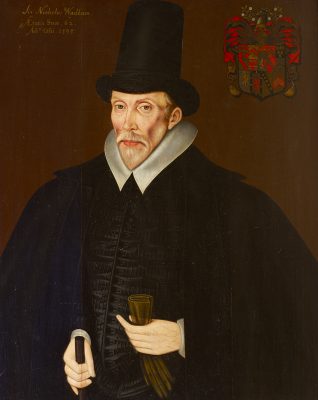
Nicholas Wadham (1531-1609)
1st cousin, 14 times removed, of Paul Borrow-Longain (by marriage)
Nicholas Wadham was born in 1531 to John Wadham of Merifield and Edge in Somerset and his wife Joan nee Tregarthin, whose family came from Cornwall. Nicholas was the only surviving son. His grandfather, Sir Nicholas Wadham, held a number of public offices being a Member of Parliament and variously the Sheriff of Somerset, Dorset and Wiltshire. He was also noted for being at the 1520 Field of the Cloth of Gold with Henry VIII.
Wadham who did not hold any title was at Corpus Christi College, Oxford before being admitted to the Inner Temple in 1553. Records show that he spent a short time at court.
He married Dorothy Petre, the eldest daughter of Sir William Petre, on the 3rd September 1555. The wedding took place at St. Botolph’s Church, Aldersgate in the City of London. At the time of the marriage, Sir William Petre was Secretary of State to Mary I, as he had been to her father Henry VIII.
The newly-married Wadhams took up residence at Ilton in the family residence, Merifield. As landed gentry, Nicholas Wadham held a range of minor public appointments. He became a Justice of the Peace for Somerset after his father’s death. Dorothy and Nicholas Wadham never had children.
The Wadham family were believed to hold Catholic sympathies which led to accusations of recusancy. Under Elizabeth I recusants were Catholics found guilty of non-adherence to the official Anglican faith. Those found guilty of recusancy were liable to a fine or imprisonment. In 1608 the Privy Council stayed recusancy proceedings against Nicholas and Dorothy Wadham The following year, Nicholas Wadham died at Merifield at the age of 77. Considered to be one of the richest fifty men in England he left substantial sums of money for various purposes. There was £500, a large sum at the time, to pay for a full heraldic funeral such as his father had received. Alms were distributed to the poor throughout Somerset. £6000 cash reserves were set aside to purchase land on which to establish a college at Oxford, with further trusts set up to endow the institution. As the only son and without children of his own to continue the Wadham name, a college named after the family would secure Nicholas Wadham’s name in perpetuity.
Despite his apparent wishes to found a new college at Oxford, Nicholas failed to put any instructions relating to this desire in his will. Instead, Dorothy, his wife who had already been named in writing as his executrix was charged by her husband on his deathbed to found Wadham College. Despite her own advanced age and some lack of clarity around her husband’s final instructions, she fulfilled his wishes within four years as a co-founder. Statues of Nicholas Wadham and his wife survive today at Wadham College inset on an external wall.
The Latin inscription between the statues translates as Nicholas Wadham of Somerset, Esquire, ordered the building of as an oral declaration (of his last will). Indeed he having been snatched away by fate he bequeathed to his wife Dorothy the completion, she without delay finished and magnificently added her own expenditure. O You Highest Father be present favourably inclined and to you (to present and to you give) we seek perpetuity.
In line with Nicholas’s final wishes, his body was interred at Wadham Chapel in St. Mary’s Church, Ilminster “where my auncestors lye interred’. His monumental tomb was constructed of Purbeck marble with an inlaid brass portrait which can still be seen today in the north transept.
