Dorothy Wadham
(1534-1618)

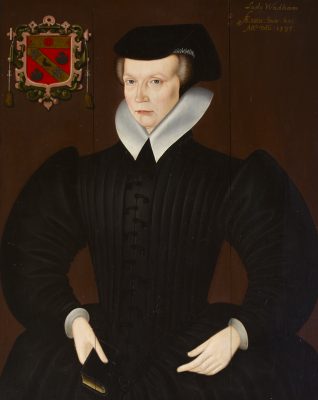
Biography of Dorothy Wadham (1534-1618)
1st cousin, 14 times removed, of Paul Borrow-Longain
Dorothy Wadham was born to Sir William Petre and his first wife Gertrude Tyrell between 1534-5. The exact date is unrecorded. She was one of two daughters and the eldest surviving child. Dorothy’s mother died in 1541 and Anne Browne, Sir William’s second wife took over the upbringing of Gertrude’s daughters. It is likely that Dorothy was educated at home at Ingatestone Hall in Essex, the Petre seat built by her father.
Dorothy’s father, Sir William Petre, rose from humble origins. The son of a Devon tanner he studied law at Exeter College, Oxford. He had an outstanding career at the Tudor court. During Dorothy’s childhood, Sir William served as Secretary of State to four monarchs: Henry VIII, Edward VI, Mary I and Elizabeth I.
On the 3rd September 1555, Dorothy married Nicholas Wadham. The wedding took place at the church of St Botolph, Aldersgate in the City of London. The Wadhams took up residence at Merifield in Ilton, Somerset, this being the principal seat of the Wadham family. The couple lived with Nicholas Wadham’s parents at Ilton, dividing their time between Merifield and a property at Edge Barton in Devon. They never had children.
The Petres and the Wadhams were believed to hold Catholic sympathies which led to accusations of recusancy. Recusants were Catholics non-adherent to the official Anglican faith, who attended Mass secretly in people’s homes. In 1608 the Privy Council stayed l proceedings against the couple. In 1613, againsuspected of recusancy, the now widowed Dorothy had her armoury confiscated. She was formally pardoned in 1615.
On 20 October 1609, Nicholas Wadham died leaving a large fortune. He made many charitable bequests as well as a trust fund intended to be used to found a college at Oxford University. Shortly before his death, he charged the 74-year-old Dorothy and a trustee, Sir John Davis, with the huge task of implementing his plan. This was not a straightforward process. Initially, Dorothy had to outmanoeuvre Sir John Davis who did not share her vision of how best to fulfil her husband’s last wishes. Sir John believed Nicholas Wadham had only intended to endow an existing college. Dorothy was adamant that her husband’s desire had been to build an entirely new college.
Dorothy Wadham, demonstrating the political skills of her father, gathered powerful allies to her cause. One of them was her brother Lord Petre, 1st Baron of Writtle. Dorothy prevailed over Davis and once free to act, she swiftly executed her plans. The land had to be purchased and buildings erected. Academic and college staff had to be appointed. Unable to travel the distance to Oxford due to infirmities of age, Dorothy had to carry out the business transactions by letter and through her agents.
Despite the challenges, only four years after Nicholas Wadham’s death, Dorothy had successfully achieved his last request. By 1613, Wadham College was established as an academic institution, complete with fellows and scholars. Dorothy had not just invested the money left in her late husband’s trust to found the college she also invested £7000 from her own money. In 1614, she transferred her lands in Essex to augment Wadham College’s funds. Dorothy is considered to be the co-founder of Wadham College. In her correspondence to the College she signed at least one letter ‘remaining always, your very loving Foundress’.
For the five years after the founding of Wadham College and until her death, Dorothy Wadham continued to deal with College matters. This included appointing staff and administering the College’s statutes. Dorothy never visited Wadham College.
Dorothy Wadham died on the 16th May in 1618 whilst at the dower house in Edge Barton. She was laid to rest in the Wadham Chapel in St. Mary’s Church, Ilminster, alongside her husband. A striking monumental brass was installed on the tomb along with one of her husbands.
